
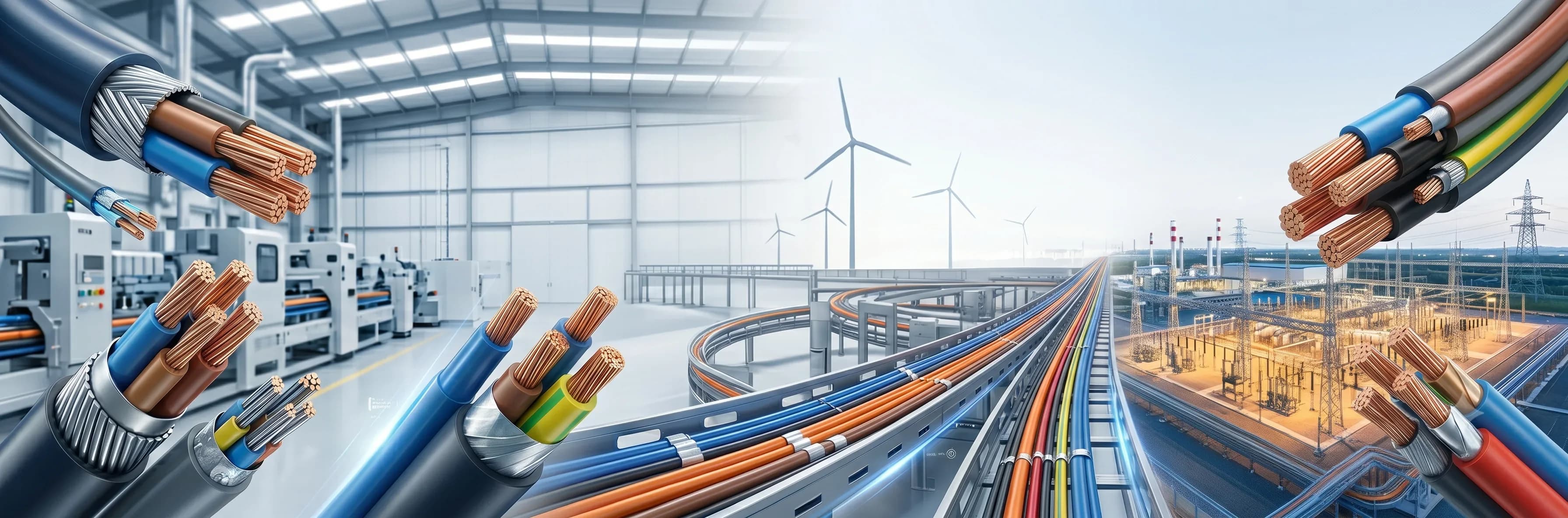
The Ultimate Guide to Cable Braiding: Functions, Materials, and Why It Matters
Fiber, copper, and steel braiding compared — how each material protects your cable and how to choose the right one.

The braiding layer is never just an accessory. Compare fiber, copper-wire (EMI shielding), and steel-wire braiding — and learn how to choose the right braided cable for harsh electromagnetic, mechanical, and tensile environments.
In the fields of power transmission and telecommunications, the structural design of a wire or cable directly dictates its operational stability and lifespan. When you strip back a high-quality industrial cable, beyond the basic conductive core, insulation, and outer sheath, you will often find a woven mesh known as the braiding layer.
Is this braided structure just an optional extra, or is it an indispensable shield? Today we dive deep into the core functions of cable braiding layers and help you choose the right braiding material for your applications.
Beyond the Basics: Why Do Cables Need Braiding?
Before exploring the braiding layer, it helps to understand the three fundamental components of any cable: the conductive core (usually high-conductivity copper or aluminum to minimize power loss), the insulation layer (to prevent radial current leakage), and the outer sheath (for moisture, corrosion, and physical protection).
However, for harsh environments involving severe electromagnetic interference (EMI), heavy physical wear, or extreme tensile stress, these three layers aren't enough. The braiding layer acts as a specialized protective overlay, playing an irreplaceable role in enhancing both the mechanical properties and electrical safety of the cable.
Fiber Braid: Lightweight Protection & Reinforcement
Fiber braiding is typically made from cotton yarn, hemp, or synthetic fibers. Depending on where it is applied within the cable structure, it serves two main purposes:
Lightweight Outer Protection (common in wires) — It acts as an environmental barrier, protecting the inner insulation from UV light, heat, moisture, and corrosive acid/alkaline gases, while reducing minor physical abrasions.
Structural Reinforcement (common in heavy cables) — In heavy-duty sheath designs, the fiber braid is often embedded between rubber or plastic layers. Acting much like rebar in concrete, it provides skeletal support that significantly increases the tear resistance of the sheath, preventing it from splitting during installation or pulling.
Metal Braid: The Ultimate Shielding & Mechanical Armor
When the application shifts to industrial control, mining, or offshore exploration, metal braiding becomes essential. This is generally divided into copper wire braiding and steel (or iron) wire braiding, each serving entirely different primary functions.
Copper Wire Braiding: Focused on EMI Shielding & Safety
Copper wire braiding is the standard for control cables, high-voltage cables, and mining cables:
Electromagnetic Interference (EMI) Shielding — Tinned copper wire braiding, frequently used in marine cables, creates a Faraday cage effect that effectively shields internal signals from high-frequency external interference.
Surface Potential Elimination — In high-voltage power cables, copper braiding helps constrain power lines and eliminate dangerous induced electrical charges, ensuring operational safety.
Earth Leakage Protection — In mining shielded cables, the braid is in contact with the earth core. If an electrical leak occurs, the conductive braid reacts instantly to trigger safety circuit breakers.
Steel Wire Braiding: Built for Extreme Physical Environments
If your cables need to survive marine exploration, heavy shipboard use, or vertical shafts, steel wire braiding (such as in CF31 marine cables) is the ultimate choice:
Maximum Mechanical Protection — Rugged resistance against impacts, crushing, and other physical damage.
High Longitudinal Tensile Strength — For vertically installed cables or magnetic survey lines, the steel braid bears the primary longitudinal breaking force and the cable's own weight.
Magnetic Field Shielding — Steel materials inherently provide a foundational level of magnetic field protection.
Conclusion: Adding Value Through Customized Braiding
The braiding layer is never just an "accessory." It is a highly customized protection solution designed for complex operational environments.
Fiber braiding perfectly balances durability with lightweight flexibility. Copper braiding resolves the hidden dangers of signal interference and electrical leakage. Steel braiding conquers the challenges of heavy gravity loads and physical impacts.
Looking for the right braided cable for your next engineering project? Whether you need high-performance EMI shielding with tinned copper or heavy-duty steel braided cables for extreme environments, our manufacturing team has the solution. Contact us to discuss your specification.
About the Author
Junjie Cheng – Senior Cable Engineer at Hongce Cable Junjie Cheng is the Senior Cable Engineer at Zhejiang Hongce Cable Co., Ltd., specializing in power cable design, manufacturing processes, and international quality control. He leads Hongce Cable’s technical team to deliver customized cabling solutions for global infrastructure and power grids. Mr. Cheng specializes in the engineering of medium-to-high voltage cables. He recently spearheaded the successful technical review and production of a RMB 5.5 million (approx. USD 760K) export project to Malaysia, delivering high-performance YJLV 6/10KV 3*150 mm² XLPE insulated aluminum power cables. His deep expertise in triple-layer co-extrusion and drum twister cabling guaranteed the strict mechanical and electrical performance required for Malaysia's power environment. Under his technical guidance, Hongce Cable ensures all products comply with IEC, BS, ASTM, and CE certifications, providing safe, efficient, and certified power transmission solutions to global B2B buyers.