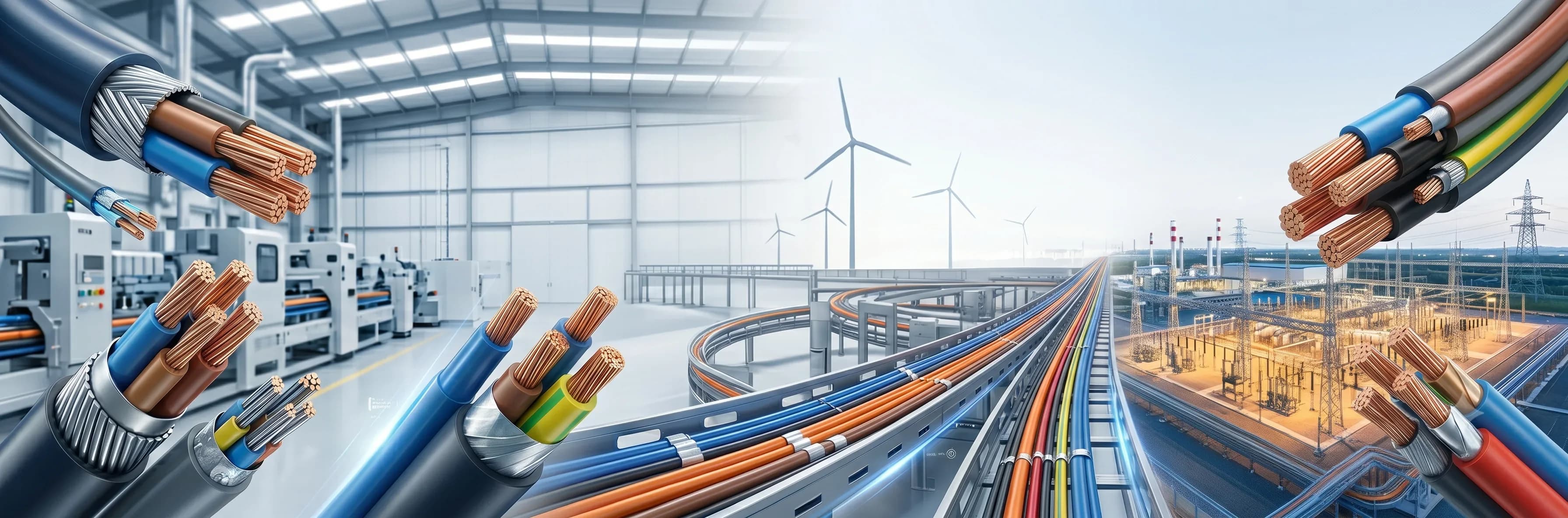
2026 Grid Hardening: YJV22, WDZN-YJY & JKLYJ Cable Standards
Selection logic, IEC standards, and procurement notes for the three cable families defining 2026 SEA grid hardening.

YJV22 armored, WDZN-YJY fire-resistant, and JKLYJ overhead — three cable families that solve three different physical problems in Southeast Asia's 2026 grid hardening cycle. Specifying the wrong family doesn't show up as a budget overrun; it shows up as rework 2 years later. Selection logic, IEC standards, and procurement notes for B2B buyers and design engineers.
Why Cable Choice Defines 2026 Grid Hardening
Southeast Asia's grid is being stress-tested from three directions at once. ASEAN annual electricity demand has compounded at roughly 6% YoY across 2023–2025, while extreme-weather events that take down distribution networks — coastal flooding, peat-fire spread, lightning-density spikes — are arriving more frequently. Three cable families carry most of the load when grid hardening budgets get approved:
- YJV22 armored medium-voltage for buried and submerged paths
- WDZN-YJY low-smoke fire-resistant for life-safety circuits
- JKLYJ insulated overhead for distribution in densely vegetated terrain
Each addresses one failure mode, and the wrong choice is expensive — not because the cable costs more, but because the failure cost cascades into substation rework, downtime penalties, and emergency replacement at 3× the planned unit price. The three most common selection errors we see on SEA tender reviews are documented at the end of this guide.
YJV22 0.6/1KV Armored Cable: Mechanical Defense for Submerged Grids
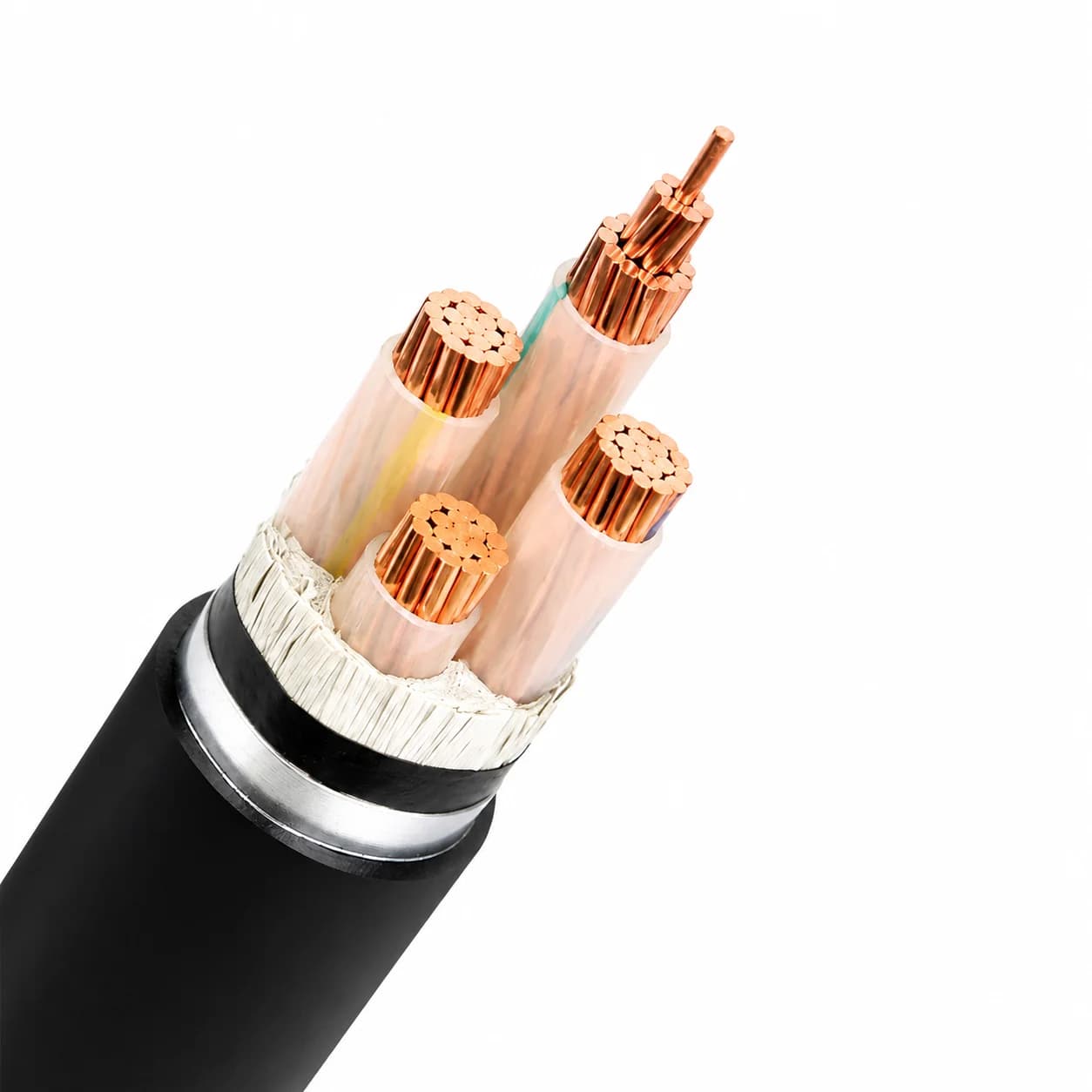
YJV22 is the workhorse for buried and water-exposed 0.6/1 kV power runs across Southeast Asia. The cable stacks copper conductor + XLPE insulation + PVC inner sheath + double-layer galvanized steel tape armor + PVC outer sheath. The armor isn't decorative — it's the difference between a cable that survives 20 years of soil movement, accidental excavation, and groundwater intrusion, versus one that fails commissioning the first wet season after a substation goes live.
Key Specifications
Parameter | Specification |
|---|---|
Cross-section range | 1.5 – 400 mm² (single-core), 1.5 – 240 mm² (multi-core) |
Voltage rating | 0.6/1 kV |
Conductor | Class 2 stranded copper per IEC 60228 |
Insulation | XLPE, 90°C continuous / 250°C short-circuit |
Armor | Galvanized steel tape (STA), double layer overlap |
Outer sheath | PVC ST2 (standard) or LSZH (life-safety variants) |
Standards | IEC 60502-1, GB/T 12706.1-2020 |
Flame-retardant rating | IEC 60332-3 Category A |
When YJV22 Is the Right Choice
The decision rule is mechanical risk first, electrical second. Specify YJV22 when at least one of these is true:
- Direct burial in non-stabilized soil — backfill movement, rodent activity, or future excavation by other trades will physically stress the cable
- Submerged or tidal-zone paths — coastal substations, jetty feeders, water-treatment plants where moisture migration into the conductor is a 5-year failure risk
- Cable trays under industrial equipment — vibration + occasional mechanical impact
Skip YJV22 (use unarmored YJV instead) for indoor riser shafts, conduit-protected runs, and clean factory cable trays where armor adds weight, cost, and installation complexity without protection benefit.
Field Failure Pattern
Across SEA distribution projects, the single most common failure mode for unarmored MV cables in buried applications is moisture migration into the conductor — typically showing up as insulation resistance failure in year 3–5, with replacement cost averaging 4–5× original installation cost once excavation and downtime are factored in. The steel-tape armor on YJV22 doesn't prevent every failure mode, but it eliminates the dominant one in tropical buried environments.
View the full YJV22 0.6/1kV technical datasheet and request a quote →
WDZN-YJY LSZH FR Cable: Life-Safety Circuit Integrity
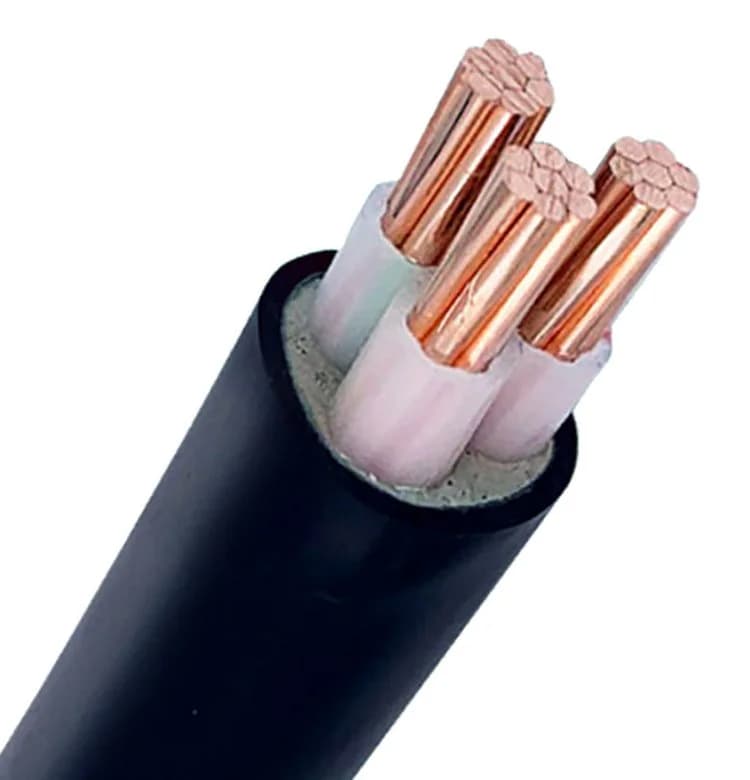
WDZN-YJY is what tender specifications call for when a circuit MUST keep working inside a fire. Smoke-control fans, fire pumps, emergency lighting risers, hospital backup feeders — these circuits failing during the first 90 minutes of a fire event is the difference between an orderly evacuation and a mass casualty incident. The cable construction layers up to deliver three independent fire properties: low-smoke zero-halogen, flame-retardant, and circuit-integrity-under-fire at 750°C.
Specification Decoder
The model code stacks three IEC-derived attributes — read it left to right:
Code | Meaning |
|---|---|
WDZ | Low-smoke zero-halogen (per IEC 60754-2 / IEC 61034) |
N | Fire-resistant: FE180 / PH120 per IEC 60331 — circuit integrity for 90+ minutes at 750°C |
YJY | Copper conductor / XLPE insulation / polyolefin sheath |
Parameter | Specification |
|---|---|
Cross-section range | 1.5 – 240 mm² |
Voltage rating | 0.6/1 kV |
Flame test | IEC 60332-3 Category A |
Smoke density | IEC 61034 (light transmittance ≥ 60%) |
Halogen acid gas | IEC 60754-1 (HCl ≤ 0.5%) |
Fire resistance | IEC 60331-21 (750°C / 90 min, circuit operational) |
Where Specification Is Non-Negotiable
WDZN-YJY appears in tender specs where building code dictates, not where designers prefer:
- Hospitals — operating theater backup feeders, ICU panel risers, smoke-control fan circuits
- Data centers — generator transfer switch feeders to critical loads
- High-rise residential (above 6 stories in most ASEAN building codes) — fire pump circuits, emergency lighting risers, smoke-extraction fans
- Mass transit — tunnel emergency lighting, station evacuation systems
- Petrochemical — emergency shutdown valve power, flare-stack ignition circuits
A Common Procurement Mistake
The most frequent cost-cutting mistake on tender reviews is substituting standard ZRC (flame-retardant only) for full WDZN. ZRC stops fire from propagating along the cable run — it does not keep the circuit energized inside a fire. Life-safety code in nearly every ASEAN market requires both attributes, which is exactly what the N + LSZH designation guarantees. The "saving" disappears immediately when commissioning rejects the install, and any project owner who has been through a commissioning failure once budgets for the full spec next time.
View the full WDZN-YJY 0.6/1kV technical datasheet →
JKLYJ 10KV Overhead Cable: Grid Losses vs. Jungle Coverage
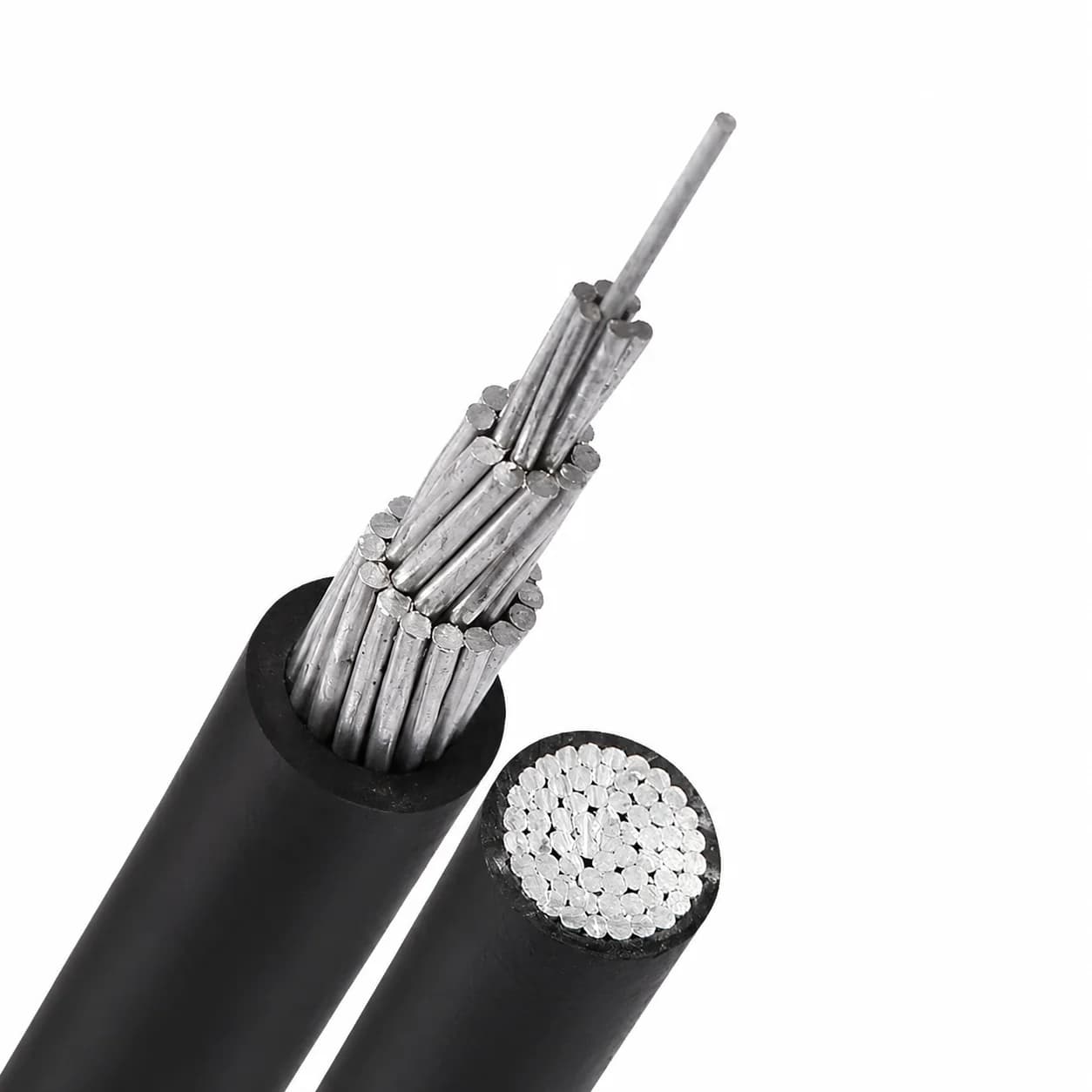
JKLYJ replaces bare conductor on the medium-voltage overhead lines that feed dense vegetation territory — palm plantations, secondary forest, rural utility distribution where trees and wildlife are constant fault sources. The aluminum conductor + XLPE insulation construction trades a ~30% per-meter cost premium against bare ACSR for a 10-year total-cost-of-ownership advantage from eliminated vegetation faults, reduced clearance maintenance, and longer mean-time-between-failures.
Specifications
Parameter | Specification |
|---|---|
Cross-section range | 35 – 240 mm² |
Voltage rating | 10 kV (also available in 15 / 20 kV variants) |
Conductor | Hard-drawn aluminum stranded per IEC 60228 |
Insulation | Cross-linked polyethylene (XLPE), UV-stabilized |
Design life | 30 years outdoor UV exposure |
Standards | GB/T 14049 / IEC 60840 (with operating restrictions) |
Span design | 40–60 m typical span (terrain-dependent) |
Why Insulated Overhead Conductor Wins in Vegetated Terrain
Bare conductor overhead lines (ACSR, AAC) carry a lower per-meter cost but accumulate three hidden costs in dense vegetation:
- Vegetation clearance maintenance — every 12–18 months in tropical climates, ongoing
- Tree-fall-induced outages — single major event can take down 6–24 hours of service across a feeder
- Animal-contact faults — monkeys, snakes, large birds bridging phase-to-ground or phase-to-phase
JKLYJ's insulated jacket eliminates the second and third entirely, and reduces vegetation clearance scope by roughly 70%. For a utility operating 200+ km of rural MV distribution in palm-plantation or secondary-forest terrain, the 10-year total ownership cost typically lands 15–25% below bare conductor, even with JKLYJ's higher initial unit cost.
Where It Doesn't Fit
JKLYJ is not a universal MV solution. Specify bare ACSR or AAAC instead when:
- Line route runs over open grassland or pasture (low vegetation contact risk)
- Span lengths exceed 80 m (JKLYJ's per-meter weight pushes tower spec)
- Substation tie-line where bare conductor cost-per-amp is the dominant economic driver
The 15–25% TCO advantage cited above assumes vegetation contact is the dominant outage cause. Where it isn't, the math flips back toward bare conductor — which is why a tender-by-tender selection review beats a blanket "always insulate" policy.
View the full JKLYJ 10kV technical datasheet →
How to Choose: A Decision Framework
When a project bid lands and the consulting engineer's BOQ specifies "MV cable, 240 mm²," the cable family choice is rarely explicit. Use this two-question framework:
Question 1: What is the dominant failure mode in this installation environment?
- Mechanical or water → YJV22
- Fire propagation or life-safety code → WDZN-YJY
- Vegetation or wildlife → JKLYJ
- None of the above + cost-driven → standard YJV or bare conductor
Question 2: What does the regulator or insurer require?
ASEAN markets are tightening building-code enforcement post-2023. Don't propose ZRC where the regulator expects WDZN, and don't propose unarmored cable for buried MV runs in jurisdictions that have updated their utility-side specifications.
When both questions point to different families on the same project, you have a mixed-spec project — that's normal. A typical SEA substation expansion uses YJV22 for incoming feeders, WDZN-YJY for control building risers, and JKLYJ on the outgoing MV distribution lines. Spec each circuit on its own dominant failure mode, not on the project's overall theme.
Conclusion
The three families covered here aren't interchangeable products in different price tiers — they're answers to three different physical questions. Substituting downwards to save 10–15% on the cable line item invariably surfaces as a 100–300% rework cost when the wrong family fails its environment.
Three practical follow-ups for project teams reviewing 2026 grid-hardening budgets:
- Bring the cable schedule to a manufacturer engineering review before tender close. A short technical review typically catches 1–2 mis-specifications per 50-circuit project — usually a downstream-substituted cable family that doesn't match the actual installation environment. The cost to fix at tender stage is the engineer's time; the cost to fix in commissioning is the entire BOQ line.
- Validate ambient temperature derating for SEA conditions. IEC ampacity tables assume 30°C ambient. In Indonesian, Malaysian, and Philippine outdoor enclosures, 45–55°C ambient is normal. Derate or upsize one step.
- Request third-party test reports with the quotation, not after. IEC 60332 / 60331 / 60754 reports from accredited labs (KEMA, TÜV, CESI, etc.) should ship with the offer. If they arrive only after PO, the manufacturer is sourcing test results from a previous order — a regulatory exposure for the project owner.
For a project-specific cable schedule review, contact our engineering team at sales@hongcecables.com or via the Get a Quote form.
About the Author
Junjie Cheng – Senior Cable Engineer at Hongce Cable Junjie Cheng is the Senior Cable Engineer at Zhejiang Hongce Cable Co., Ltd., specializing in power cable design, manufacturing processes, and international quality control. He leads Hongce Cable’s technical team to deliver customized cabling solutions for global infrastructure and power grids. Mr. Cheng specializes in the engineering of medium-to-high voltage cables. He recently spearheaded the successful technical review and production of a RMB 5.5 million (approx. USD 760K) export project to Malaysia, delivering high-performance YJLV 6/10KV 3*150 mm² XLPE insulated aluminum power cables. His deep expertise in triple-layer co-extrusion and drum twister cabling guaranteed the strict mechanical and electrical performance required for Malaysia's power environment. Under his technical guidance, Hongce Cable ensures all products comply with IEC, BS, ASTM, and CE certifications, providing safe, efficient, and certified power transmission solutions to global B2B buyers.